We often think of calories as the dreaded thing you don’t look at when you have that fast food meal you had promised yourself you would avoid. However calories are important energy units and important especially with fuels.
Fuel oil is an essential component of many industries, including transportation, manufacturing, and power generation. To ensure the quality and efficiency of fuel oil, it is necessary to perform various tests, including the determination of the fuel’s heat of combustion. This can be achieved through the use of a bomb calorimeter, as outlined in ASTM D240.
What is a Bomb Calorimeter?
A bomb calorimeter is a device used to measure the heat of combustion of a substance. In the context of fuel oil analysis, it is used to determine the heat energy released when a sample of fuel oil is burned in a controlled environment. This information is crucial in determining the fuel’s energy content, which can affect its performance in various applications.
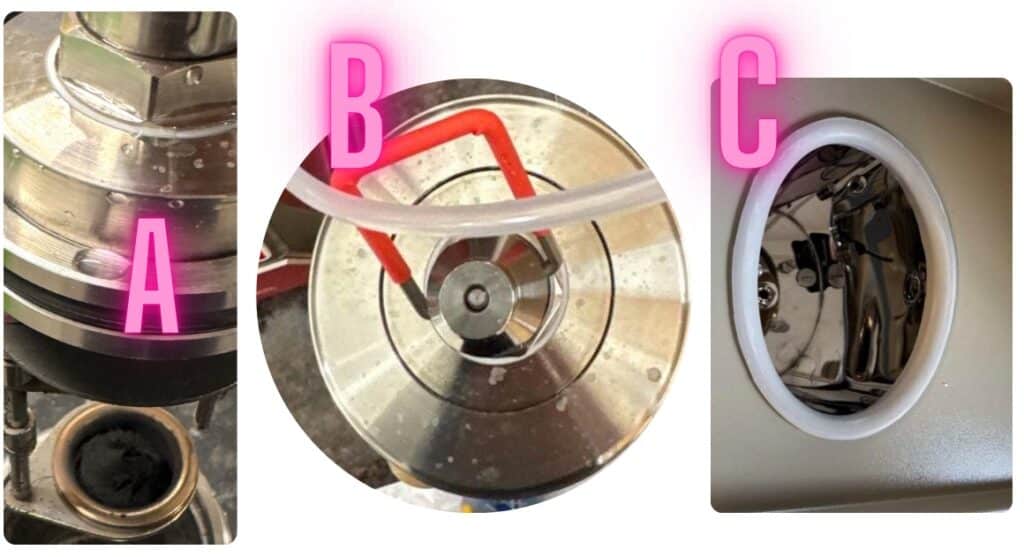
What happens during the test?
What is a calorie?
When we talk about calories in food we often mean kcal or kilocalories (1000 calories) when we talk about a calorie. In this sense 1 kcal is how much energy it takes to raise 1kg of water by 1 degree c.
How does a Bomb Calorimeter Work?
The bomb calorimeter consists of a sealed vessel, known as a bomb, which contains the fuel oil sample and an excess of oxygen. The bomb is then submerged in a water bath, which is kept at a constant temperature. The fuel oil is ignited using an electric current, causing it to burn rapidly in the presence of oxygen. The heat generated by the combustion is absorbed by the water bath, causing its temperature to rise.
Being an internationally recognised method it also means the units used need to be standard units ie not imperial and so the mega joules is the unit of choice for the test.
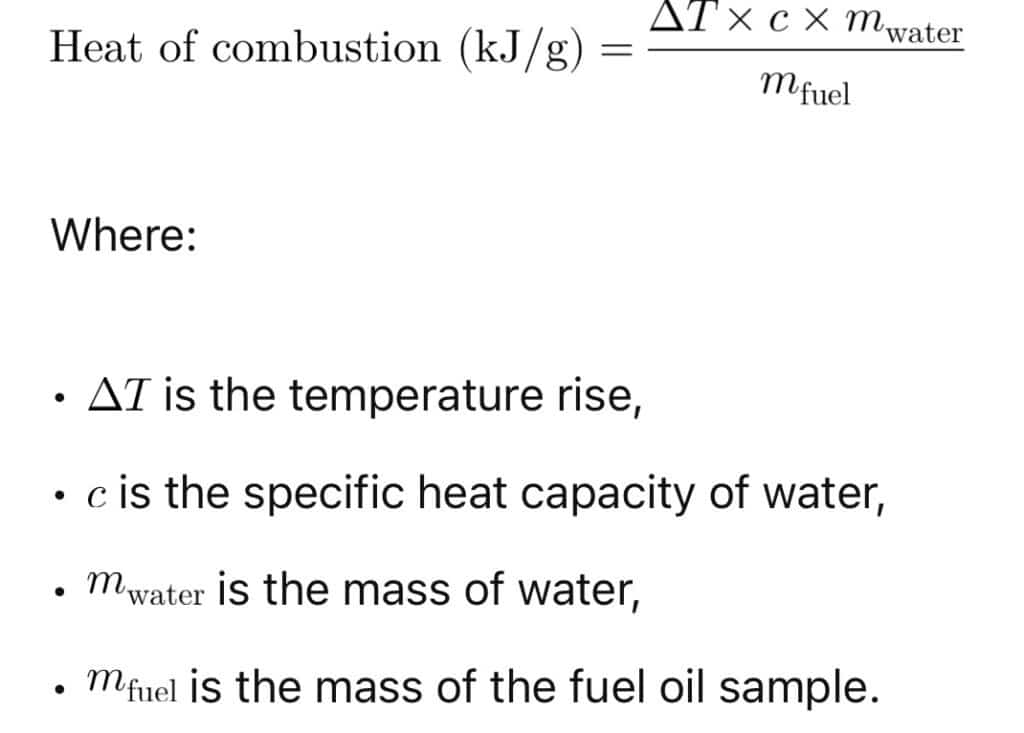
The temperature increase of the water bath is measured using a thermometer, and the heat of combustion is calculated using the following formula:
Importance of Sample Preparation
Proper sample preparation is crucial for accurate results. This includes ensuring the fuel oil sample is homogeneous and representative of the bulk material.
Corrections and Adjustments
The calculation of heat of combustion often requires corrections for factors such as heat of formation of nitric acid, heat of combustion of the fuse wire, and sulfur content in the fuel.
Safety Considerations
Operating a bomb calorimeter involves high pressures and temperatures. Proper safety protocols, including the use of personal protective equipment, are essential.
A quick recap of the test again
The ASTM D240 outlines the procedure for determining the heat of combustion of liquid hydrocarbons, including fuel oil, using a bomb calorimeter. The test involves the following steps:
- Sample preparation: A small sample of fuel oil is weighed and placed in the bomb, along with an excess of oxygen.
- Calibration: The bomb calorimeter is calibrated using a standard material, such as benzoic acid, to ensure accurate results.
- Test run: The bomb is submerged in the water bath, and the fuel oil sample is ignited using an electric current. The temperature rise of the water bath is measured and recorded.
- Calculation: The heat of combustion is calculated using the formula mentioned above.
- Reporting: The results are reported in units of kJ/g or multiples of this unit.
Other Relevant ASTM Standards
There is with most things more than one way to burn a fuel and there are several other internationally recognised methods including ASTM D4809 for heating value of liquid hydrocarbon fuels for measuring calorific values. Why is this important? Well each test method can give slightly different answers. If you want a general idea of the caloric value of a product then to be honest they will all come out about the same. However, if you have a particular specification you are working to please confirm with the lab the method and indeed any deviations you require for testing to gain the most repeatable results.
Conclusion
The bomb calorimeter is an essential tool for fuel oil analysis, providing valuable information about the fuel’s energy content. By following the ASTM D240 standard test method, laboratories can ensure accurate and reliable results, aiding in the optimization of fuel oil performance and efficiency.
If you are looking for reliable and efficient oil analysis services, contact us today. Our team of experts can help you with all your fuel oil testing needs, including heat of combustion determination using a bomb calorimeter.