


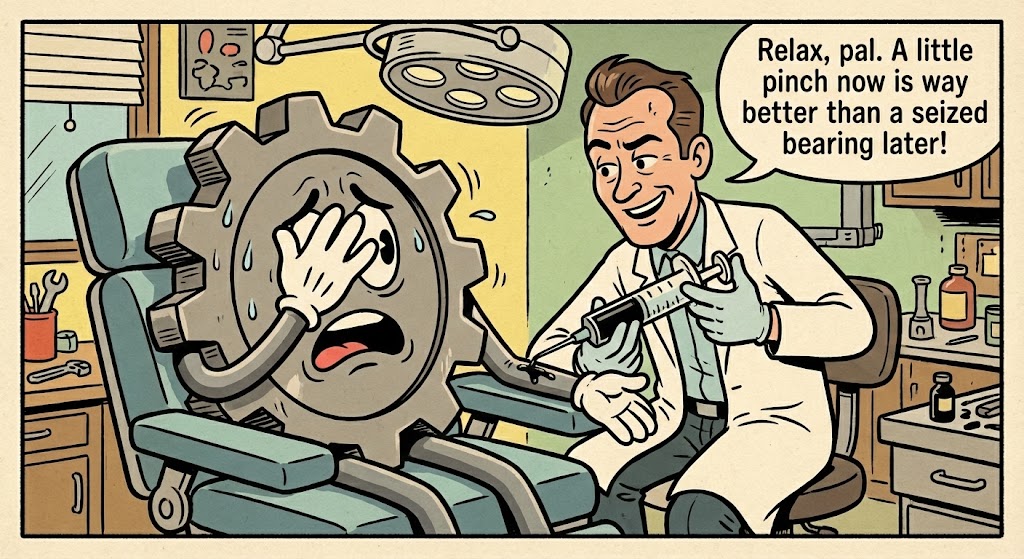
Oil Analysis: The Blood Test Your Equipment Never Knew It Needed
Why the smartest maintenance teams treat their machines like patients — and how you can too.
Its often joked, that if I cut myself I bleed 15W40, which got me thinking. You wouldn’t skip a blood test when your doctor says something might be off. Quick draw, few numbers on a page, and you know whether your cholesterol is creeping up or an infection is brewing. All before you feel a thing.
Your equipment works the same way. Except nobody orders the test.
“Run It Till It Breaks” Is Expensive
We still see it everywhere. Something fails, everyone scrambles, production grinds to a halt, and the repair bill lands with a thud. Emergency repairs cost 3 to 9 times more than planned maintenance — and that’s before you count lost production, overtime, and the knock-on effects when delivery schedules slip.
The really frustrating part? The oil running through that machine was showing warning signs for weeks. Sometimes months. Nobody looked.
Oil Touches Everything
Think about what oil actually does. It’s in constant contact with every moving part — lubricating, cooling, cleaning, carrying debris away. As components wear, microscopic particles end up floating in it. As the oil degrades, the chemistry shifts.
One sample, drawn correctly and sent to a decent lab, tells you:
- Which components are wearing, and how fast
- Whether something has got into the system that shouldn’t be there (water, dirt, fuel, coolant)
- How much life the oil has left, so you change it when it actually needs changing, not on some arbitrary schedule
- Whether the machine is healthy, developing a problem, or heading for the scrapheap
That’s not maintenance. That’s proper diagnostics.
What’s Actually on the Report
Viscosity
This is the big one. Think of it as the oil’s “vital sign” — it measures how thick the oil is and whether it can still form a film between moving surfaces. Viscosity drops? Might be fuel dilution or shear. Viscosity climbing? Could be oxidation or contamination thickening things up. Either way, something’s changed and you want to know why.
Wear Metals
The lab uses ICP Spectrometry to measure metals like iron, copper, and aluminium in parts per million. Each one points to different components — iron means gears or cylinders, copper means bearings or oil coolers, aluminium usually means pistons. And when metals move together? That’s where it gets really interesting. Copper and lead rising at the same time is practically a flashing sign that says “bearing overlay wear.”
But a single reading on its own doesn’t tell you much. Trending is where the real value lives. Three or four samples over time and you’ve got a story; one that gives you time to act before things get expensive.
Particle Count (ISO 4406)
This one uses a three-number code (like 18/16/13) to describe how many particles are in your oil at different sizes. High numbers mean the system’s dirty. The targets depend on what you’re running: hydraulics need much cleaner oil than a gearbox, but the principle is simple. Cleaner oil, longer life. We’ll dig into this one properly in a future post.
TAN and TBN
Total Acid Number tells you how acidic the oil’s become through oxidation. Rising acid = the oil is degrading and starting to get corrosive. Total Base Number is the opposite, it’s the oil’s remaining ability to neutralise those acids. Especially important in diesel engines where combustion byproducts are constantly attacking the lubricant.
When the TBN runs out, corrosion speeds up fast. Monitoring both together tells you how much useful life the oil actually has left.
FTIR Spectroscopy
Fourier Transform Infrared Spectroscopy. Sounds intimidating, but it’s basically a chemical fingerprint of what’s happening to the oil. It picks up oxidation, nitration, sulfation, water all the degradation mechanisms that slowly eat away at performance. It catches things that the other tests sometimes miss.
Show Me the Money
A routine oil analysis runs about £40-70 per sample. A single unplanned gearbox failure? Easily £50,000+ once you add up the replacement part, the emergency callout, the downtime, and the production you’ve lost while everything’s being put back together.
But it’s not just about dodging the big failures. Oil analysis also saves money in less dramatic ways:
Oil change intervals. Why drain oil that’s still doing its job? Analysis tells you when the oil actually needs changing. Plenty of organisations find they can safely extend drain intervals by 25-50% once they’ve got the data to back it up.
Equipment longevity. Machines running on clean, properly conditioned oil simply last longer. Lower wear rates, lower operating temperatures, components staying in spec for longer.
Smarter scheduling. Instead of doing PM because the calendar says so, which might be too frequent or not frequent enough. You maintain based on what’s actually happening inside the machine.
Getting Started
You don’t need to sample everything. Start with the machines where failure would hurt most — your expensive assets, production bottlenecks, anything safety-critical.
Get your sampling right from day one. Same sampling point, same operating conditions, clean equipment. Bad samples produce bad data, and bad data produces bad decisions.
For most industrial kit, a standard package of viscosity, wear metals, particle count, TAN/TBN, and FTIR covers the essentials. Your lab can suggest extras for specific applications.
The first few samples are just baselines. Don’t read too much into them individually: you’re building a picture of what “normal” looks like for each machine.
And then — this is the bit that separates the good programmes from the ones that quietly die. Actually do something with the results. An oil report sitting in someone’s inbox is worthless. Build a simple process: results come in, someone reviews them, abnormalities get flagged, actions get scheduled.
Wrapping Up
Oil analysis isn’t exotic and it isn’t new. The best maintenance operations in the world have been doing this for decades. The technology is mature, the ROI is well-documented, and the only question is whether you start listening to what your oil is telling you…or wait for the machine to make the point more forcefully.
Your equipment is talking. Might be worth listening.
Want to learn more about oil analysis, report interpretation, and building a condition monitoring programme that actually works? Have a look at what we offer at learnoilanalysis.com.